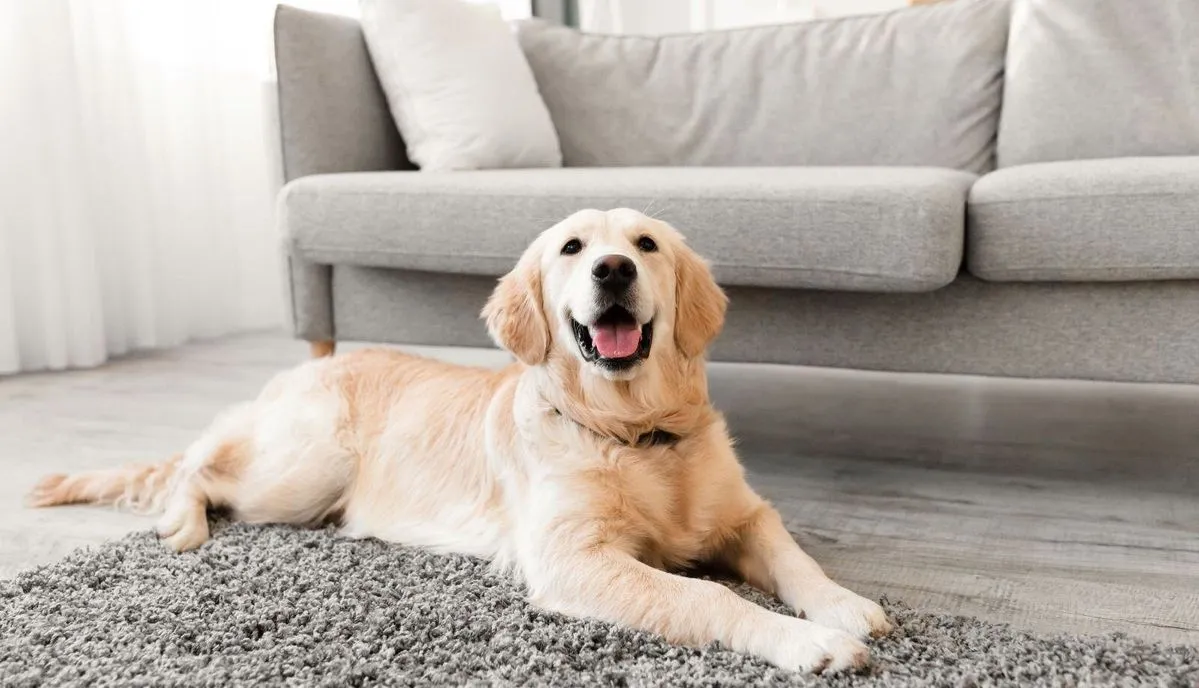
Your dog is your best friend. Your cat is family. But when a puppy has an accident on the living room carpet — or a senior cat starts missing the litter box — that love gets tested by a smell that just won't go away.

You've scrubbed the spot. You've sprayed every product the pet store sells. The stain looks gone. But every time the humidity rises or the heater kicks on, that unmistakable odor comes back. That's not a cleaning failure — it's chemistry. The source of the smell isn't on the surface anymore. It's deep in the carpet padding, and most DIY methods can't reach it.

This guide explains why pet urine odor is so persistent, what actually works as a first response, what makes things worse, and when professional pet stain and odor removal is the only real solution. Based on 10+ years of pet odor treatment across NJ, NY, and CT.
Why Pet Urine Odor Is So Hard to Remove
To understand why that smell keeps coming back, you need to understand what’s actually in pet urine — and what happens to it after it soaks into your carpet.
Fresh urine contains urea, urochrome (the yellow pigment), bacteria, and hormones. When it first hits the carpet, it’s relatively easy to blot up. But within hours, bacteria begin breaking down the urea, producing ammonia — that sharp, eye-watering smell you recognize immediately.
Here’s the real problem: as urine dries, it forms uric acid crystals. These microscopic crystals embed themselves deep in carpet fibers, padding, and sometimes even the subfloor. They’re insoluble in water, resistant to most household cleaners, and nearly invisible to the naked eye.
The worst part? Uric acid crystals reactivate with moisture. Every time humidity rises — and if you live in New Jersey, you know our summers are relentless — those crystals release odor all over again. That’s why a spot that smelled “clean” in January becomes unbearable by July. The stain isn’t coming back. It never left.
Cat urine is especially challenging. It’s more concentrated than dog urine, contains higher levels of protein and felinine (a sulfur compound), and produces a stronger, more persistent odor as it decomposes. Older cat urine that has dried and crystallized over weeks or months is one of the most difficult odor problems in residential carpet cleaning.
DIY First Aid: What to Do Immediately After an Accident
Speed matters more than anything else. The faster you act, the less urine soaks into the padding — and the better your chances of avoiding a permanent odor problem.
Step 1: Blot — Don’t Scrub
Grab a thick stack of paper towels or a clean white cloth. Press down firmly to absorb as much liquid as possible. Lift straight up and repeat with dry towels until no more moisture transfers. Work from the outside edge inward to avoid spreading the stain.
Never scrub. Scrubbing pushes urine deeper into the padding and damages carpet fibers — making the problem harder to fix later, whether you go DIY or professional.
Step 2: Apply an Enzymatic Cleaner
This is the single most important product choice you’ll make. An enzymatic carpet cleaner contains live bacteria cultures that produce enzymes specifically designed to break down the organic compounds in urine — urea, proteins, and the uric acid crystals that cause recurring odor.
Standard cleaners mask the smell or dissolve the surface stain, but they can’t break down uric acid. Enzymatic cleaners are the only consumer-grade products that attack the actual source of the odor at a molecular level.
How to use them correctly: Saturate the affected area thoroughly — the cleaner needs to reach the same depth the urine did. Cover with a damp cloth or plastic wrap to keep the area moist (enzymes need moisture and time to work). Leave it for 12–24 hours. Don’t rush this step. Blot dry afterward.
Quality enzymatic cleaners worth keeping on hand include Nature’s Miracle, Rocco & Roxie, and Angry Orange. Avoid bargain brands — enzyme concentration matters, and weak formulas won’t reach deep enough.
What NEVER to Do With Pet Stains
Some of the most common reactions to pet accidents actually make the problem permanently worse. Avoid these at all costs.
Never Use a Steam Mop or Steam Cleaner
Heat permanently bonds protein-based stains — including urine — into carpet fibers. Once you apply steam to a pet stain, the protein sets like a cooked egg. The discoloration becomes permanent, and the odor gets locked deeper into the fiber structure.
This is one of the most expensive mistakes we see. A stain that could have been fully removed with proper treatment becomes irreversible after one pass with a steam mop.
Avoid Ammonia-Based Cleaners
Ammonia is a natural component of decomposing urine. When you clean a pet stain with an ammonia-based product, your dog or cat smells what it interprets as another animal’s marking — and their instinct is to mark over it. You’re essentially inviting repeat accidents in the same spot.
Don’t Rely on Baking Soda Alone
Baking soda absorbs surface moisture and temporarily neutralizes some odor. But it can’t break down uric acid crystals, and it can’t reach the padding where the real problem lives. It’s fine as a supplemental step, but it’s not a solution on its own.
When DIY Isn’t Enough: The Professional Approach
Enzymatic cleaners and fast blotting can handle fresh, isolated accidents. But there are situations where DIY methods hit a wall — and continuing to throw store-bought products at the problem just wastes money while the damage deepens.
Signs you need professional pet odor treatment:
- The odor returns every time humidity rises or the heat turns on
- Multiple accidents have happened in the same area over weeks or months
- You can smell urine but can’t locate the exact source
- You’re preparing a home for sale or new tenants
- You’ve tried several products and the stain or odor persists
Professional carpet odor treatment goes far beyond what any consumer product can do. At Atom Cleaning Co., our process starts with a UV light inspection — uric acid crystals fluoresce under ultraviolet light, revealing every affected area, including old stains you didn’t know existed. We map the full extent of contamination before any cleaning begins.
For moderate cases, we apply commercial-grade enzymatic treatments directly to the carpet and padding, at concentrations and contact times that consumer products can’t match. For severe or repeated contamination, we treat the sub-floor itself to eliminate crystals that have penetrated beyond the carpet.
The final step is truck-mounted hot-water extraction — professional equipment that injects heated water at high pressure deep into the carpet and immediately extracts it along with dissolved contaminants, dead bacteria, and broken-down uric acid. Carpets dry in hours, not days. The odor source is physically removed, not just masked.
Safe for Your Pets, Safe for Your Family
We get this question on nearly every pet-related job: “Is it safe for my dog to walk on the carpet after cleaning?”
Yes. Every cleaning solution Atom Cleaning Co. uses is pet-safe, non-toxic, and eco-friendly. No harsh fumes, no chemical residue, no risk to dogs, cats, or children. We recommend keeping pets off the carpet until it’s fully dry — typically 4–6 hours — but once dry, it’s completely safe.
Pet-safe carpet cleaning isn’t just a marketing phrase for us. It’s a requirement — because we’re pet owners too, and we wouldn’t use anything in your home that we wouldn’t use in ours.
Stop Chasing the Smell — Eliminate It
If you’ve been cycling through store-bought sprays, baking soda, and DIY scrubbing without lasting results, the problem isn’t your effort — it’s that the contamination has moved beyond what surface methods can reach. Uric acid crystals in the padding and subfloor require professional extraction, not another bottle of spray.
Atom Cleaning Co. provides specialized pet stain and odor removal across NJ, NY, and CT — using UV detection, commercial enzymatic treatments, truck-mounted hot-water extraction, and 100% pet-safe solutions. Free assessment before quoting. See our carpet cleaning services for details or get a free quote in 24 hours.